Category: History

The Pump Room

“Your father’s state of health must be a great drawback. Why does not he try Bath? Indeed he should. Let me recommend Bath to you.”
-Jane Austen, Emma


 photo pumproom1_zps9254c7fa.jpg

After the Roman baths, the next best thing in Bath is the 18th century Pump Room. It features in Austen novels, Gillray’s cartoons lampooning the Regency’s main figures, and countless travelogs. Largely unchanged since it was built, it was one of the main places for people to meet and greet, see and be seen in the 18th and 19th centuries.

 photo pumproom2_zps8d9ac7cd.jpg

And without doubt, the focal point is the fountain where do this day you can pay 50p to “take the waters,” as those who came to Bath over the years did to improve their health. On this visit, I was happy to just take pictures. I’ve tasted the water, and I’m convinced it’s more kill than cure.

 photo pumproom3_zps5ab906f0.jpg

The restaurant is lovely. I heartily recommend taking tea if you get the chance.

 photo pumproom4_zpsae6565ea.jpg

And those three performers? Apparently they are called the Pump Room Trio, and as an institutional group, they are the longest established residential ensemble in Europe. Knock back your tea (or mineral water, if you’re a masochist) and scones listening to beautiful classical music while feeling you most Austen-esque.

Bath

“Your head runs too much upon Bath; but there is a time for everything — a time for balls and plays, and a time for work. You have had a long run of amusement, and now you must try to be useful.”
– Jane Austen, Northanger Abbey

 photo Bath1_zps27aa2f3c.jpg

 photo Bath2_zps71e51a7d.jpg

Obviously the most famous thing in Bath is…the Roman bath complex! A combination of historic site and museum, it’s well worth the cost of the tour. Like most places in Britain these days, you pick up an audio guide that takes you around the museum and through the baths, allowing you to set both the pace and amount of information you want to take in. There are also options for children who might not want to spend hours staring into collections of votive offerings to the goddess of the hot water spring like, er, some people…

 photo Bath4_zps33730b72.jpg

The Baths are right next door to the Bath Abbey. If you love historic cathedrals like, er, some people again it’s worth a look in, but if not you can admire it from outside just fine and move on to other things.

 photo Bath5_zpsb40633a2.jpg

The Baths are still flowing and still heated by the self same spring that fed it in the Roman era. Look closely and you can see steam rising up above he water in certain places.

 photo Bath6_zpsea5c0d78.jpg

This is the entrance to the spring itself, with a bit of Roman civil engineering thrown in for good measure.

 photo Bath7_zpsa6c771cf.jpg

The thing about Bath that really makes it worth a visit is that it’s just so very pretty. It’s utterly picturesque. The primary building material is the iconic limestone that is quarried from the area that gives a light sort of feeling to the entire city. It rises up out of the dark green hills, with tendrils of creamy stone curling through the river valley. The elegant Georgian architecture doesn’t hurt either.

 photo Bath3_zpsc14fdc6e.jpg

It’s hard to explain how something like rock can be so alluring but I personally think Bath is at its best in twilight. The stone gives off a warm sort of glow that makes everything look like a Jane Austen mini-series. Ironic since she might be Bath’s most famous resident (and the locals trot her out at every opportunity), but she didn’t particularly like it there.
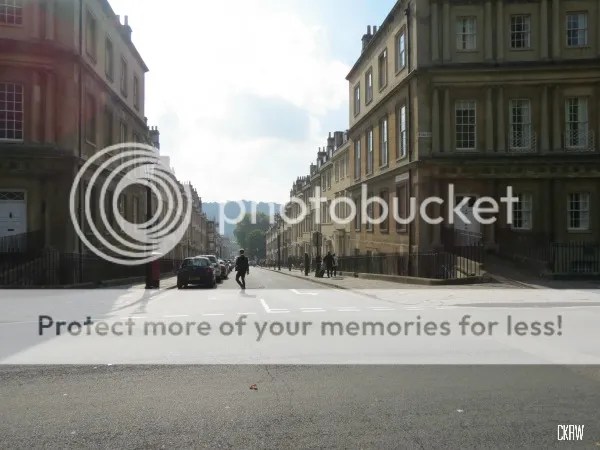
 photo Bath8_zps355b0cf2.jpg

It’s a very British thing to talk about the weather, but it must be said that the “green and pleasant land” pulled out all the stops for my in-laws’ visit. The weather was perfect throughout the entire trip, and I’m fairly certain I got more Vitamin D in their week visiting than I had in the previous six months!

 photo Bath9_zpsfd2139bf.jpg

 photo Bath10_zps2653bc7c.jpg

The other major site we took in was Number 1 Royal Crescent, a Georgian home that’s been restored and furnished to look as it would have in the late 18th and early 19th centuries. Everyday items like hair scratchers (necessities for ladies who might have had their hair washed and set once a quarter) and mousetraps are displayed alongside formal dining and reception rooms. You can head up the main staircase, or tromp down the servants’ one to get a taste of life above and below stairs during the period.

 photo Bath11_zpse21a44ad.jpg

Last but not least: FOOD. Sally Lunn’s is a Bath establishment. It’s fairly simple fair, but there has been a bakehouse on this site for centuries (and some excavations have revealed there may have been one in Roman times as well!). The current house dates from the 17th century and got its name from a French Huguenot baker who set up shop who created the “Bath bun,” a large and fluffy roll of white bread. Sally Lunn’s serves all meals, with a side of her famous bun with each portion.

 photo Bath12_zps4626a225.jpg

We stumbled across The Circus cafe and restaurant on our way to the Royal Crescent and decided to take a late lunch there. A helpful sign informed us that it was ranked #4 in a nationwide list of “restaurants that only foodies know about,” and I can see why. My lunch of roasted squashes and vegetables with a pomegranate sauce and some magical concoction of goats cheese was easily the best dish I had on the entire trip. The food is locally sourced, season, and excellent–and most importantly, very reasonably priced for what you get.

Cambridge Part 7: The Wanderings

I find Cambridge an asylum, in every sense of the word.
-A.E. Housman

Just a few shots leftover from our Cambridge adventure that were too good not to share.

 photo wander1_zps1df00145.jpg

This sign is simple, but I thought it one of my loveliest snaps of the day.

 photo wander2_zps16e61cbd.jpg

In case you missed my write up on the best places to eat (hint, it’s right here) this is the side entrance of The Anchor which is on Laundress Lane, across the street from the world’s most charming bike and rental shop.

 photo wander3_zpsbf74966d.jpg

If you go to Cambridge, you must eat at Fitzbillies. I insist. I might even drag you there myself.

 photo wander4_zps8f528191.jpg

No biggie.

 photo wander5_zpsd864df24.jpg

It’s hard to overemphasize how much Henry VIII is omnipresent in Britain. He’s (understandably) most often remembered in pop culture for his marriages, but the truth is that those episodes were mostly short and crammed together into the back half of his reign. His most controversial wife, Anne Boleyn was only married to him for around three years while Anne of Cleves (lucky woman) was only wife number four for a matter of weeks. His marriage to Katherine of Aragon lasted for 20 years by comparison. He brought the Renaissance to England (largely kicking and screaming) and throughout his reign he enacted a number of laws and reforms that turned England from a feudal and medieval backwater that most of Europe sighed about, rolled their eyes at, or schemed to overpower, into a force to be reckoned with.

As a result, his mark is everywhere. The ruins of abbeys and monasteries dot the country, his effigy turns up in surprising places, the royal supremacy he developed still holds in theory, and his direct touch is stamped over the history. He might have been a thoroughly nasty fellow and a terribly bad person, but I think a decent argument can be made that at points he was a good or at least effective king and certainly one of the most influential in history. Make of that what you will.

 photo wander6_zpsf1bbf125.jpg

The Senate House, a gorgeous piece of neoclassical architecture alongside the medieval and Victorian ones.

 photo wander7_zpsb824622d.jpg

Lunch on the Cam.

Cambridge Part 6: The Haddon Library

“In a good bookroom you feel in some mysterious way that you are absorbing the wisdom contained in all the books through your skin, without even opening them.”
― Mark Twain

I’m furious to report that the photos of the first room we entered on our way to the Haddon Library didn’t turn out at all. This room was dark, stuffed with shelves filled with books about ancient Babylon, first contact with the Zulu, Assyrian and Egyptian glossaries, and other fabulous finds. Some of the old tomes containing early maps were nearly as tall as me. And it turns out that the room had a slightly scandalous recent history.

The academic who was in charge of interacting with visitors told me the story of a recent department reshuffle when collections of libraries were combined and had to be moved from one location to another. Not only did they have to worry about the proper transfer of historically significant books, they also had to be sure that the order and classifications were preserved–putting a collection like this back together from scratch if it was scrambled was too daunting a task to be thought of! Luckily the professor in charge found a moving company that specializes in this and a disaster was avoided.

It didn’t seem like too many visitors were going to the Haddon Library through this entrance and the professor and librarian talked to me for nearly twenty minutes simply because I started asking questions about the massive books. It’s always a delight to me what you can learn about the workings of places and people if you just pull up a chair and are genuinely interested.

The Haddon Library itself looks like a Victorian Eccentric’s private room and it’s wonderful. It supports primarily Anthropology students and research. What I loved was the old card catalog still there and still in use. No school like old school. Literally in this case.

 photo haddon1_zps005bb911.jpg

 photo haddon2_zpse0eec7fc.jpg

 photo haddon3_zps6f362706.jpg

 photo haddon4_zps3dd8fd0d.jpg

Cambridge Part 5: The Parker Library

“A room without books is like a body without a soul.”
― Marcus Tullius Cicero

My very idea of heaven is a library, but this is just ridiculous!

 photo parker1_zpsee2b88e0.jpg

The building itself was designed by William Wilkins, who also designed the National Gallery.

 photo parker4_zps667015aa.jpg

Excuse me while I sit on my hands to keep from stroking the bindings inappropriately.

The Parker Library in Corpus Christi College houses one of the most impressive collection of medieval manuscripts in the world, one to make the eyes of a nerd like me absolutely pop out. The Anglo Saxon Chronicle, a 15th century Chaucer manuscript, a glossary from the 800s, and the Gospel of St. Augustine, which is considered the oldest book in Britain and is believed to have been brought to the country by St. Augustine of Canterbury when he first came to spread Christianity to the English. It’s the oldest illustrated gospel in the Western world, and is used at the enthronements of the Archbishops of Canterbury.

 photo parker2_zps89d70878.jpg

The library’s collection can really be attributed to the 16th century clergyman Matthew Parker. He served as the private chaplain of Queen Anne Boleyn and under Queen Elizabeth I became Archbishop of Canterbury. We owe his collection to Henry VIII’s dissolution of the monasteries, after which the centuries old libraries that these institutions once houses were flung far and wide. Parker got permission to collect whatever books he found useful, and thank goodness. His collection includes a quarter of all known Anglo Saxon manuscripts today.

 photo parker3_zpse94522e7.jpg

 photo parker6_zps1daa02ca.jpg

A letter written by Anne Boleyn to her father while she was serving as a lady-in-waiting at the French court.

For the open day, the library also included several pieces from the personal collection of Dr. John C. Taylor, who designed the Corpus Clock.

 photo parker5_zps4578a690.jpg

In other words, Jeff had to drag me away from this place…

Cambridge Part 4: The Corpus Clock

“Time is an illusion.”
― Albert Einstein

Cambridge has a number of distinguished and distinguishing landmarks, most of which are medieval, early modern, or in some way dating from before the 20th century. The Corpus Clock, housed at the library of Corpus Cristi College, is unabashedly modern. Normally facing the street, for Open Days the wall was turned to allow library visitors to get an up close and personal look at and within it.

Invented and designed by Dr. John C. Taylor (who has an amazing collection of clocks which will also feature in tomorrow’s adventures), it is a strange and wonderful creation. The face is plated in pure gold and the design is a rippled effect, created by explosions within a vacuum. They symbolize the Big Bang, the impact of which set space and time into motion and exploded outward. At the top is a grasshopper-like creature that Dr. Taylor calls the “Chronophage,” meaning “time-eater” (which is apparently a pun since an 18th century horologist referred to a clock mechanism as a grasshopper).

It has no hands and tells time through concentric rings of lights to signify seconds, minutes, and hours. When the hour strikes, all the lights flash. And yet it is purposefully designed to appear irregular and sometimes be irregular; the pendulum appears to catch or the lights race and lag. The whole point is to be functional, but also show the somewhat threatening nature of time. The beast (which is apparently nicknamed both “Rosaline” and “Hopsy” by locals and students) swallows the seconds without ceasing, and if you look closely you may catch it blinking or moving its mouth unexpectedly. Time flies, it’s untrustworthy, it’s easily consumed or lost, and there’s no getting it back.

 photo clock2_zps9d1d4255.jpg

Pointing out the features of the gold plated exterior.

 photo clock3_zps185761c5.jpg

But look inside…

 photo clock1_zpsb6dd0abb.jpg

 photo clock4_zps453600f8.jpg

…and the almost science fiction quality is revealed!

 photo clock5_zpse7b59209.jpg

I scrambled up another level in the library to get a less obstructed view because I found the clock unexpectedly delightful. I love seeing things cracked open and their inner workings revealed.

Budding videographer that I am (she laughed!), I snapped a short video of the clock’s function being presented. The speaker does a better job of explaining the lighting sequence than I could, plus you get to see the creature’s movement.

Cambridge Part 1: Open Days

“Bottled, was he?” Said Colonel Bantry, with an Englishman’s sympathy for alcoholic excess. “Oh, well, can’t judge a fellow by what he does when he’s drunk? When I was at Cambridge, I remember I put a certain utensil – well – well, nevermind.”
― Agatha Christie, The Body in the Library

I’d wanted to work with The Collaboreat ever since I heard Bethany was starting it up, so when they called for post ideas with an academic bent to celebrate back-to-school season, I pitched profiling the best eats in Cambridge. This was not entirely without self-interest. I’d wanted to go back to Cambridge for a while and Jeff had never been, it was the end of summer, and we were dying to get out of the city and spend some time together after his latest round of exams. So, those safely behind us, we picked a Saturday early last month and found a train deal.

 photo cambridge1_zps097da793.jpg

 photo cambridge2_zps2f472f36.jpg

In the great debate of which is better of the Oxbridge schools, my punt is firmly in the river Cam. My mother got a degree from there and I’m quite loyal. I also hoped to to attend and nearly got in. A single selecting academic said no, earning my everlasting rancor. But, thanks to Mum’s example of dogged determination to get yet another degree a bit later than typically done, I haven’t entirely ruled it out.

 photo cambridge4_zps3c85a717.jpg

 photo cambridge3_zps12c469b3.jpg

As it happened, we could not have picked a better day if we tried! By sheer dumb luck we ended up in Cambridge on an Open Day, where many of the sites of the city you couldn’t normally get into (certainly not without paying) were available to the public for free. The colleges pulled out their best wares for showing off and there were chances to wander through libraries and chapels and grounds to our hearts content.

 photo cambridge5_zps68ecf2bc.jpg

I have an unholy love of getting into places I shouldn’t. So…come take a peek around with me this week!

Tall Ships Festival Part II

“A ship in the harbor is safe, but that’s not what ships are built for.”
― William Shedd

Some more shots from the Tall Ships Festival around the Royal Naval College and the Cutty Sark. The day started out fairly overcast but cleared up beautifully by the afternoon and I got to enjoy the sun bathed history to my heart’s content. Royal Museums Greenwich had a naval encampment on its green to show some of the skills employed by the navy and river-side Thames dwellers who supported them.

 photo ships21_zps01b6fd92.jpg

 photo ships22_zps615ca1f2.jpg

 photo ships23_zpsec2640f5.jpg

Not quite Horatio Hornblower, but pretty nifty all the same.

 photo ships24_zps8bfb36ac.jpg

 photo ships25_zps3720fec2.jpg

Blacksmith.

 photo ships26_zps7611ee71.jpg

Wool dyeing with natural and old school methods.

 photo ships27_zpsf7de06af.jpg

Cartography.

 photo ships28_zps09268f01.jpg

Call out the marines!

 photo ships29_zpsa0fcc79c.jpg

 photo ships212_zpse4553dd3.jpg

Unlike some of the other vessels, the Cutty Sark is not a small ship.

 photo ships211_zps457fed01.jpg

Lord Nelson is feeling serious.

 photo ships210_zps50caf3f8.jpg

Sir Walter Raleigh is feeling sassy.

Tall Ships Festival Part I

“A whale ship was my Yale College and my Harvard.”
― Herman Melville

I think that it’s easy for some people to forget that Britain, with all its history and wars and books and world impact…is a group of decently small islands. There isn’t a spot that is more that 70 miles from a coastline throughout the whole of the country, the sea is ever present. Plus through much of recorded history, Britain was covered with bogs and marshes in addition to being crisscrossed by rivers. In other words, boats and ships have been an intrinsic part of British history.

This is especially true in London with its prime spot along the Thames. It has been a major travel and shipping hub for centuries and if you take a look at almost any historical representation of the city, you will see ships depicted as lining the river with masts as thick as as forest. Though the Thames is a lot less crowded these days, it’s fun to get a glimpse of the city’s maritime history, which is why I trotted along to the Tall Ships Festival in Greenwich a few weeks ago.

 photo ships1_zpsa0e249cd.jpg

 photo ship2_zpsc386939e.jpg

 photo ships3_zpsf4a9d249.jpg

A mix of historical presentation and street food, this sort of thing was straight up my alley and I ended up walking nearly six miles along the river to look at the variety of sailing ships moored so that visitors could have a chance to board and get a sense of what this vessels were like. There were also costumed interpreters and amateur naval enthusiasts parading around in clever and wacky get ups as only the British seem to be able to do.

 photo ships4_zpscc1d32be.jpg

 photo ships5_zps005f308f.jpg

 photo ships6_zps635bc87c.jpg

What most people don’t realize is that most sailing ships were tiny, almost unbelievably small. Explorers and privateers circumnavigated the globe in crafts not much longer than a bus with about as much personal space. As a child I had some idea that ships were solid things but getting to see them up close and personal you realize that they are as much rope as they are beams and are quite literally tied together in a lot of cases. One wrong knot and you’ve lost a major function that could leave you and your entire crew lost at sea.

 photo ships7_zps814bbbdf.jpg

At one point, the British navy was virtually populated by kidnapped men and criminals, largely commanded by child officers who had purchased commissions, and funded by a prize system that turned almost everyone into privateers. It was kept in check by a system of legalized brutality and fueled with some of the worst food imaginable with a side of drunkenness. And it was a system that conquered the world, led to some of the most important scientific finds of human history, and kicked off globalization. A complicated history that deserves being better known.

House Guards and Horses

“It’s hard to lead a cavalry charge if you think you look funny on a horse.”
― Adlai E. Stevenson II

Meandering past Horse Guards Parade in Westminster a couple of weeks ago, we got the unexpected pleasure of seeing the riders and horses put through their paces. The Household Cavalry are made of of some of the most prestigious regiments of the British Army due to the fact that they are members of the Queen’s personal guard. Their history goes back to the 17th century and their museum (housed in the Horse Guards building), which forms the traditional entrance to St. James’s Palace, is well worth seeing if you’re interested in British military history.

 photo guards1_zpse2325ef9.jpg

The first hint that something was going on was the sound of hooves on stone.

 photo guards2_zps577d78c5.jpg

Inspection.

 photo guards3_zpse4e2df11.jpg

The other half of the guards regiment (the Life Guards are in Red, the Royal House Guards and and 1st Dragoon, also called the Blues and Royals, are in the blue. For obvious reasons).

 photo guards4_zps809dff42.jpg

 photo guards5_zpsf747ae59.jpg

Of course, the men are only half of the stars of the show.

 photo guards6_zps23df273f.jpg

I was really impressed to see the riders actually on guard while on horseback. Specifically that the horses were tolerating the hordes of tourists butting up against them to try and get pictures without kicking them straight in the head. I was waiting for some kind of equine disaster, but the training the horses get is impeccable.

 photo guards7_zpsa39aeb5f.jpg