“It is plain that men are in charge of making saints.” – Karen Cushman, Catherine Called Birdy
How to properly celebrate St. Valentine’s Day:
Also, build yourself a cathedral if you can, it adds swagger points.
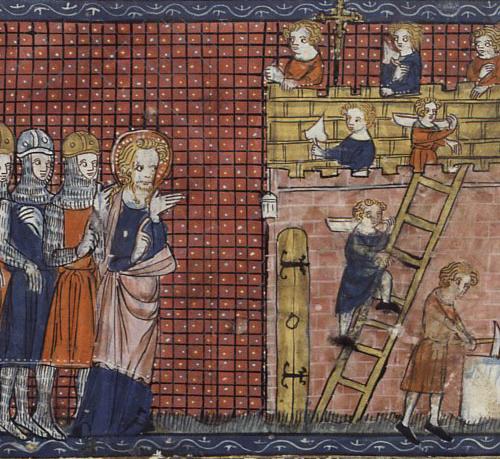
1) Be a Roman priest during the reign of the Emperor Claudius Gothicus (because that name definitely belongs to a benevolent, wise, un-tyrannical autocrat), perform marriage ceremonies for Christians, get caught, and when on trial foolishly try to convert said unfortunately named emperor. Survive a terrific beating, stoning, and finally die when guards run out of ideas and behead you.
1a) Or maybe be an early Christian convert who gets martyred (like they tended to do), but be fuzzy on the actual death details (also like they tended to do).
1b) Or finally be an obscure early Christian hermit who, neglecting utterly to conform to the social expectations of the time, failed to be martyred at all.
2) Fade into even more complete obscurity
3) Have Chaucer casually mention the tradition that February 14th is the day that birds choose their mates and forever after be associated with romance and love.
4) Stew for nearly another 700 years and enjoy the romance, kids!
“I personally believe we developed language because of our deep inner need to complain.”
– Jane Wagner
We all have word pet peeves, times when people use phrases incorrectly, insert words that don’t actually mean what they think it means, or when society at large is responsible for corrupting a word’s usage. I probably take my particular pet peeves too seriously, but it cannot be helped.
“Ironic” – which does not mean unfortunate, coincidental, silly, funny, aggravating, or any of the other things Alanis Morrissette can now be blamed for teaching us to think it means.
An excellent example of common modern usage.
“Ye”-as previously mentioned, anytime you see a sign showing “Ye Olde [something], you’re not actually looking at a “y” but at an Old English character called “thorn” which makes a “th” sound.
This confusion is somewhat understandable as it is most commonly found in England where several linguistic invasions have made the language something of a puzzle for most who try to learn it as a second language. Pear, pair, and pare, you try explaining that one. Or the reason knight isn’t spelled night, when in other words a “gh” produces and “f” like in laugh. Or why, depending on where you’re from, you may spell civilisation as civilization. Or why English doesn’t really have rules, only exceptions.
First the Celts came to Britain, after possibly conquering another group of people who were there first, and as far as we know didn’t have much in the way of writing. There are some hatch mark symbols carved in stone but these seem to have been a clumsy, tedious sort of way of keeping track of things and so they decided instead to rely on memory which they trained to fantastic levels (and where did you leave your keys this morning?). Then came the Romans who brought Latin and other previously unknown practices (see Decimate below). But then their empire, as it had become by this time since they’d given up most pretensions to a republic, caught a nasty case of “The Collapsings” and the legions were recalled from Britain, leaving the Romanized population unprotected and understandably miffed.
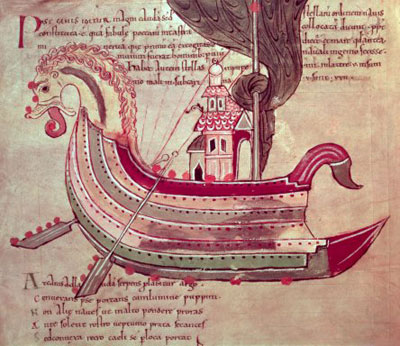
I think it's time for a trade up, lads!
The Anglo Saxons (go here and carefully note the caption!), watching this from their Germanic homesteads with glee, could see an upwardly mobile real estate deal when it presented itself, so bunches of the upped sticks and sailed over. They originally were hired as mercenary protectors by the Britons, but they didn’t go in much for togas compared to rape and pillage and within a few years had taken over and set about to dividing into small kingdoms and declaring war on each other to their hearts’ content. They also brought their language, on which somewhat better records were kept. A few centuries later, just as soon as they’d got themselves unified into some semblance of order and had started keeping excellent chronicles, a Norman across the Channel decided he ought to be king. William the Bastard, for that was his unfortunate name, invaded and won. He ousted the Anglo Saxon lords and installed his own Old-French-mixed-with-Latin-again speaking cronies instead, further enriching the language and changing his name to the much more impressive sounding William the Conqueror.
But, in spite of each subsequent invader’s attempt to quash the language of those who came before, the invaded stubbornly held on to an impressive lot of their old languages and culture, which is why something as old as a millennium old written character that looks like “y” and sounds like a “th” is still bulldogish-ly refuses to go away. Which is good because “Yee old [anything]” sounds absolutely ludicrous.
Apostrophe – I know this isn’t a word, but you know what I mean. People will throw this little mark wherever they think something should go, but for the life of them don’t know whether it’s a different spelling, contraction, or trying to show possession.
There/Their/They’re – And while we’re on the subject! These are totally different words, figure ’em out!
Had this been painted a week earlier, it would have depicted the farmer's wife and children still alive. One must admire his optimism here, yes?
“Medieval” – used when people mean backwards. Actually refers to a distinct period in Western history which was complex, interesting, and full of people trying desperately to push their way forward out of the mess that Rome put them in after dividing, collapsing, and embarrassingly allowing itself to be ripped to shreds by barbarian hordes. Western standards of music, culture, and literature were developed during this period. Architecture, which had become an utterly lost art was redeveloped literally from the ground up. The ideas of credit, and banking were invented. The whole period is a heartening example of human beings being knocked into the sludge over and over again with invasions, plagues, more invasions, famine, and a couple of other invasions, and consistently picking themselves up, dusting off the disease and gore, and getting back to the difficult business of human advancement.
Irregardless – This is not, in fact, a word. At all. Don’t use it. Ever.
“Decimate” – Once upon a time, there was an empire that was cheerfully burgeoning in the centuries BC. Not that they called themselves an empire, oh no! That would have sounded barbaric and unenlightened. They called themselves a Republic, the Roman Republic to be exact, and since they were so enlightened and grand, the ideal career for a spry, young Not-Empire was to invade all their nearest neighbors and force them to submit to their rule. Really there were few things this adolescent Republic liked better than sauntering into Germany, Greece, or North Africa and casually killing a few thousand people before breakfast.
"Tough luck, Flavius." "Son of a Gaul!"
Not content with brutality directed at the unwashed masses they were trying to subdue (so that they could tax and enslave the snot out of them), occasionally when one of their vicious battalions mutinied or were insufficiently enthusiastic about marching off to slaughter, the commander would order them decimated. Meaning that they would be divided into groups of ten, draw lots, and whichever one of them pulled the short straw was stoned or bludgeoned to death. Literally it meant to reduce by one tenth.
Nowadays, the term decimation is used, completely at odds with its origin and etymology, to mean when people, places, or structures are reduced by cataclysmic proportions (although the American media is prone to exaggeration in this regard: “That windstorm last night decimated trees and power lines!” for example, when maybe one or two were knocked down). Decimated does not mean destroyed, wiped out, broken, mildly damaged, and dirtied up.
“Like” – “It was, like, so hard! I mean, like, I’ve never had to do anything that bad since, like, I had to pick out my, like prom dress!” The word “like” means similar to. Or fond of. It can be used as a conjunction, verb, or adverb, it is NOT an equivalent to “um…”
“Oh, confound all this. I’m not a scholar, I don’t know whether the marriage was lawful or not but dammit, Thomas, look at these names! Why can’t you do as I did and come with us, for fellowship?”
“And when we die and you are sent to Heaven for doing your conscience and I am sent to Hell for not doing mine, will you come with me, for fellowship?”
– A Man for All Seasons
Truth is that while fairy tales (not of the gruesome original variety, the Disney-fied kind) like to depict people getting rewarded for sticking to their principles, quite often the blessing one gets for standing by one’s standards, ideals, and beliefs is a public flogging, or worse. And the measure of our character is whether we will endure the blacklisting, loss of status, loss of friends, back-against-the-wall-ness of it all with dignity and come out with our convictions still in place.
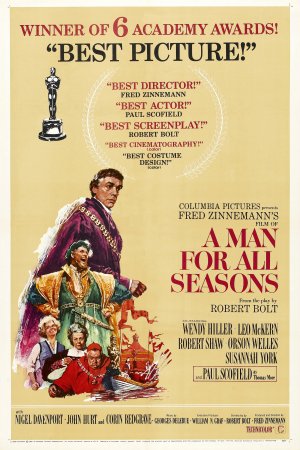
And so! A Man for All Seasons is required viewing. Paul Scofield gives a a subtle but brilliant performance of a man who managed to be both conflicted and steady and who ultimately decides to stand by his faith, but more importantly his conscience. The movie could easily have been a trite morality play, but it isn’t. It’s as complex as the idea of conscience and morality itself.
The story is set during one of the most tumultuous centuries for faith and conflict in Western history and England. Henry VIII has thrown over Katherine of Aragon for Anne Boleyn, and the Catholic Church for one of his own making. None of which sits right Sir Thomas More (Scofield) who, quietly but firmly, says he cannot change his religious beliefs to suit even a king, cannot change his legal opinion to flout the law, and will not go against his conscience even to save his life.
I do not mistake this film for history. The historical Thomas More was a Catholic zealot who saw six “heretics” burned to death under his administration as Lord Chancellor, but he was also a humanist who thought women were just as academically capable as men and gave his daughters the same classical education as his sons. I don’t mind the simplified, or rather focused, view of a certain part of his life, historical accuracy isn’t the point of this film. A man having his friends, protectors, and even household turn against him, while he sticks to his moral guns is.
Ideals are seldom complex and people never are. More defends bad laws made by men because the universal concept of Law gives protection, he encourages humility to an ambitious friend while being named Lord Chancellor, he insults another friend to keep him distant in order to protect him from the political fallout of being friends with a “traitor,” and argues for justice at his unfair and mock trial.
Moral of the story: decide what you hold dear, and defend it. Even if it costs you.
“Difficile est saturam non scribere.”
– Decimus Iunius Juvenalis
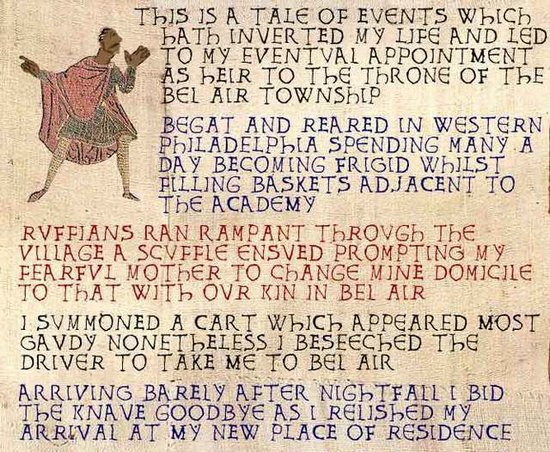
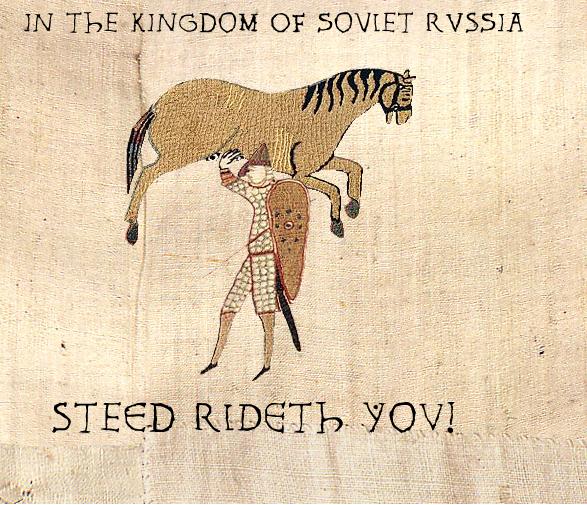
In continuing C.-is-a-history-dork news, I’ve discovered an entire internet meme genre I didn’t know existed, based on the Bayeux Tapestry. How could I not have known of this?!
Oh, remember when this was a sassy comeback? In the 11th century?
Ye Olde CSIFresh Prince of Bel Air-ford.The pun appropriately named Sir Mix-a-Lot.J. likes Soviet Russia jokes. My favorite! An old childhood computer game, "The Canterbury Trails!"
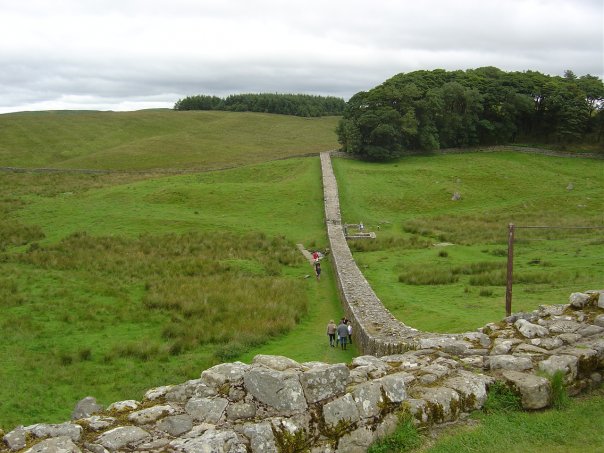
Hands down my favorite family holiday was trekking along this thing. Glean from this confession what you will.
In case you forgot, I love history. I find it fascinating. I joyfully memorized dates in school and wrote fantastic papers. Not that I had a hope or prayer of doing otherwise – my family’s library is a massive thing divided into Theology, my father’s collection of Modern Library first editions, classics, children/young adult literature, and history with an emphasis in the development of Western Culture. Our family vacations are not to theme parks as much as hiking Hadrian’s Wall, Normandy, Colonial Williamsburg, museums, castles, palaces, and ruins (true story about how all four kids, aged 20, 14, 12, and 10 climbed all over a Roman fort that was partially submerged in a stream looking for the carved symbols hidden at the base meant to protect it – which may or may not have been relief carvings of genitalia – because it was something we had never seen before in our many adventures in various Roman piles of rocks) . We are DORKS.
And everyone knows the best way to grow a dork is to start young! Ergo I bring you, Horrible Histories: a humorous, outrageous, and engrossing (emphasis on the “gross”) medium for bringing history to the masses. “It’s history, with all the horrible bits left in.” Timelines, explanations, and facts interspersed with tidbits of the unusual, gory, or just plain bizarre. And Britishly funny!
Titles such as The Savage Stone Age (Horrible Histories), Villainous Victorians (Horrible Histories), and The Vicious Vikings and the Measly Middle Ages (Horrible Histories) virtually speak for themselves. Illustrated by the delightful Martin Brown and others, there are puns, jokes, incredible stories, side-splitting captions, and all manner of fun. I’d recommend them to anyone who wants to stuff their kids’ heads with something without the child catching on to the parent’s nefarious scheme to make them enjoy getting smarter. You can buy them on the cheap, often starting as low as $.01 on Amazon, I already own a sizable (and growing) collection that still makes me laugh.
“If you wait a few minutes you can have a piece of cake. Baked it chock-full of love, actually chock-full of unrelenting, all-consuming rage and hostility. But still tasty.”
-Grey’s Anatomy
I made light of it but yesterday’s brush off (you know, when I delivered fifty years of an otherwise undocumented perspective on the growth of the university, state, and country through some of the most turbulent social decades of the previous century…nothing big) was a crushing blow. I’ve been coasting along blissfully at work ever since my rage stroke without caring too much about the administrative snafus that I seem to see everywhere.
But then this happened and my entire academic life flashed before my eyes. I wondered if all my education even mattered, if I’d ever be able to use it again, what would become of me, blah blah blah. It was rough. To make it worse it was compounded with hormones and J. wanting to talk about our future (grad school, loans, working now, internships). The overwhelming sense of uncertainty blended nicely into the tempest already brewing in my teapot.
Cue minor meltdown. I started baking immediately. I hate cooking of all forms so for me it’s the ultimate cathartic experience: I can take out my emotions by beating eggs, shredding carrots, and pummeling dough into submission, and come out with something sugary at the end. Perfect. Luckily Venice and I met somewhere in the middle – she needed butter, I needed Midol – and I got a nice heaping dose of perspective, as she’d had a pretty wretched day too.
She’s been suffering at work for years now. And unlike me, she doesn’t have lots of really great co-workers and supervisors to make the stupidity and drudgery less irksome. (Don’t go, Venice! Er…ahem…) Twenty minutes complaining about work, mutual resolve to learn to cope better, and I was ready to talk grad school with J.
Summary: Friends and muffins make everything, even the occasional crisis of faith, better.
“We have top men working on it right now.”
“Who?”
“Top men.”
– Indiana Jones and the Raiders of the Lost Ark
Pictured: a villain immediately preceeding his revalation of exactly how badly he has been behaving for the last hour and a half.
In almost every movie there is that incredibly silly moment when the villain is confronted with the fruits of his or her destruction and, looking over the rivers of lava/ looming black hole/ annihilation of an entire civilization/ etc., murmurs in despair, “My god, what have I done?!”
I had one of those moments today. After getting all the archives into chronological order (which you’d think they’d already be in, right? Hah!), tagging them by date, pulling original photos and making notes on when/where they originally occurred in print, and hauling it one massive armload at a time to the library, I asked for the archivist. Student employees helped me carry the stacks of papers and binders and asked what I was doing. I couldn’t very well shout, “Saving history!” in the library, so I quietly whispered the tale of the iniquitous order to dispose of fifty years of information.
“He told you to shred it!” one girl squeaked in horror.
“I know,” I squeaked back.
We were all awash with the enthusiasm of the young until the archivist appeared. He looked like Eeyore the donkey in human form: droopy, awkward, exhausted, and less than thrilled to see me with my arms full of documents.
“Hi, I’m C. from the police department. We talked on the phone and–”
“Oh, right,” he sighed, “Follow me.”
The whole cavalcade meandered down some halls and through secured doors…to a lonely room, lined with shelves and piled with papers.
“Here’s a project for you,” he mumbled to what appeared to be a heinously overworked student employee, and ordered us to drop the whole pile on her (already covered) desk.
My project is somewhere alongside the Ark, I'm sure.
Which is when I had my cinema-villain-is-confronted-by-what-she’s-done moment. I’d committed the most rookie of cardinal sins: I’d just turned over fifty years of history to a bureaucracy!
I’ve gained all sorts of skills and experiences at this job, but law enforcement is not my calling, to say the least. But history! Oh, yes. And this project is the first thing in over a year and a half that’s come close to the things I’ve studied and feel passionate about. Certainly it’s the only thing that’s got me excited enough to annoy my co-workers with my near constant cries of, “Read this!” And now, I’ve an awful premonition that my precious bundles are only going to slowly decompose in the bowels of the library. There is no justice in the world.
“All the ancient histories, as one of our wits say, are just fables that have been agreed upon.”
-Voltaire
Yesterday Lt. Citrus called me into his office and waved his hand at a pile of binders. It was the media files archives of our department, newspaper clippings mostly, and it went back to 1960.
“We don’t need these anymore,” he said. “Can you get rid of them and save the binders?”
?!?!?!?!
I stretched out my hands dumbly and let him plop a stack in my hands and then tottered back to my desk where I opened them up.
The Civil Rights movement, the Vietnam War, the first female officer to graduate from the state’s police academy…the earliest documented complaints about parking (an as yet unresolved problem!) when we had a fraction of the student number we do now…a completely unique perspective on the history of the campus was sitting on my desk and I was supposed to just shred it?! Clearly they forgot I majored in history!
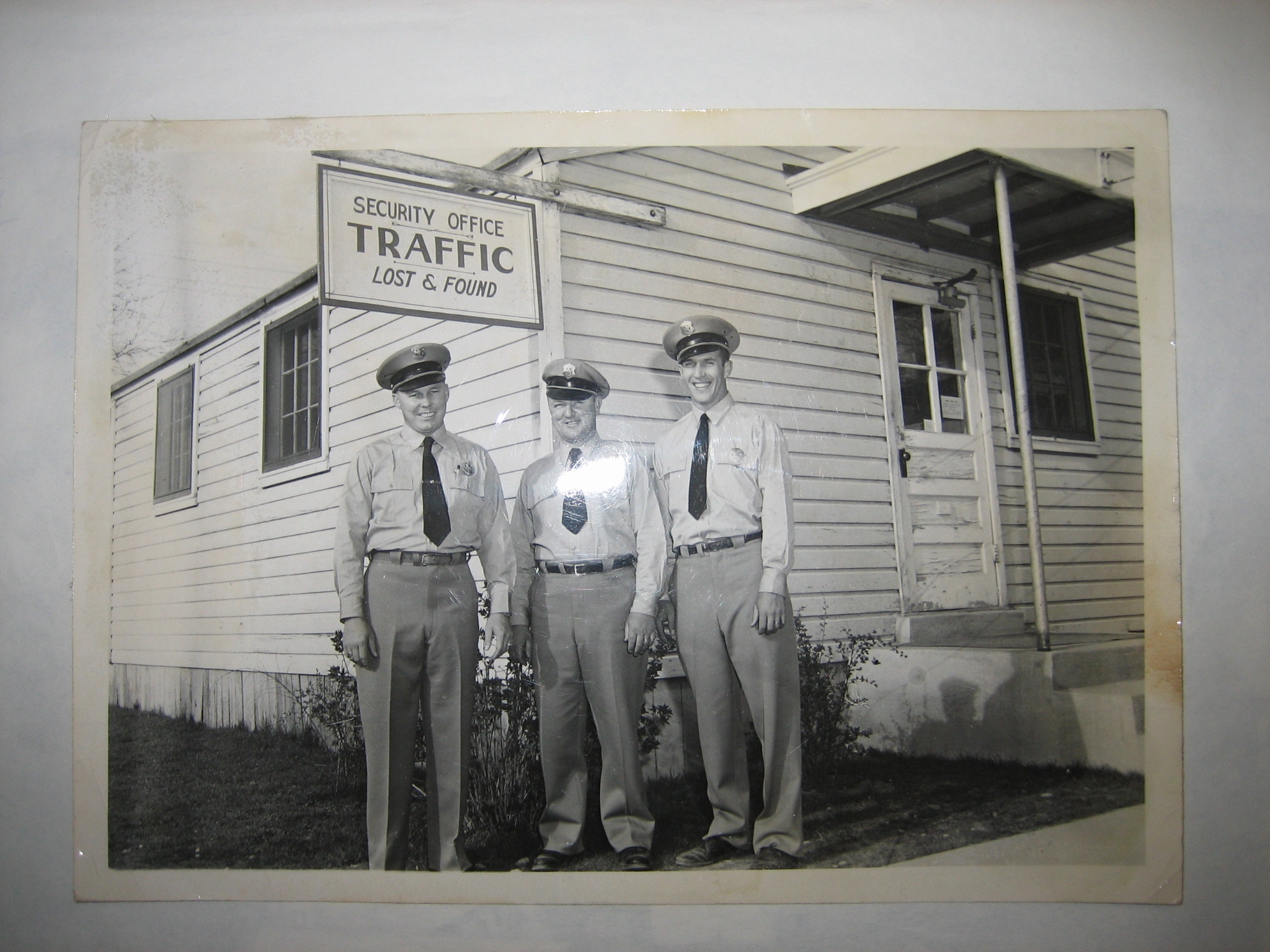
I begged off my other chores and began putting things in order. I’ve spent the last day and a half scanning articles and photos that document the history of the department (beginning back when we had an ex-LA cop fish a bunch of wallets out of the campus pond and search for the owners, all the way to the 40+ full time, state-certified officers we have now along with nearly 200 student employees). And come across some real gems!
Throw this stuff away. Pfft! I’m already in contact with the university archivist.
Showing off items abandoned in the Lost and Found. The one on the right kind of looks like Peggy Olson from Mad Men.Contrary to popular belief, we neither live in Mayberry, nor whistle frequently.
“Hear now a sorry tale of mortal man…”
– Aeschylus
The story of Prometheus is well known, but to recap… He was a titan who apparently sided with the Olympians when they wandered into Greece, looked around, and said, “We’ll take it.” Even though Zeus declares himself supreme-overlord-of-all-and-if-you-challenge-me-you-will-get-struck-by-bloody-lightning-I-am-not-kidding!, Prometheus demonstrates over and over again that he is far more clever than the majority of the pantheon. While Zeus is sneaking around behind his wife’s back, preening in a mirror, and trying (unsuccessfully) to keep his growing horde of illegitimate children quiet, Prometheus decides that he feels like creating humans and developing agriculture, writing, and the other civilizing arts.
"That'll learn you, thinking you're smarter than me..." "Wow. You're a huge jerk. Ow ow OW!"
But when he decided to steal fire (usually symbolizing technology in general) for mankind and smuggled it off Mount Olympus, Zeus finally lost it. Fed up with his tricks, overwhelming cleverness, and making him (Zeus) look bad, he chained Prometheus to a mountain and sent an eagle to eat his liver everyday, which miraculously regrew each night so he could be tortured in the same way daily, ad infinitum. One of the pesky downsides to being immortal.
The modern retelling of this myth is currently taking place on our front counter.
In an effort to help transition patrons to the new parking system, an unnamed officer bought two tiny laptops that our employees could use to walk individuals through the online process of registering their cars. Trouble was that for months the system was hovering in a state of semi-productivity limbo, even on a good day the internet connection on the laptops is shoddy at best, and the computers are almost never used. Not money well spent, in my opinion.
Not aesthetically pleasing, I feel.
However, one of the more obvious problems with this idea has been the method devised for keeping them in place (as it would be embarrassing for computers to get stolen from a police department); to wit, a tangled mass of wires, power strips, and chains wrapped around one another, the computers themselves, and drawer handles. Looking both ghetto and ridiculous.
Moral of the story: trying to bring enlightenment and ease to the populace will probably make you an object of aggravation, fit only to be tied up and left to rot.



 is required viewing. Paul Scofield gives a a subtle but brilliant performance of a man who managed to be both conflicted and steady and who ultimately decides to stand by his faith, but more importantly his conscience. The movie could easily have been a trite morality play, but it isn’t. It’s as complex as the idea of conscience and morality itself.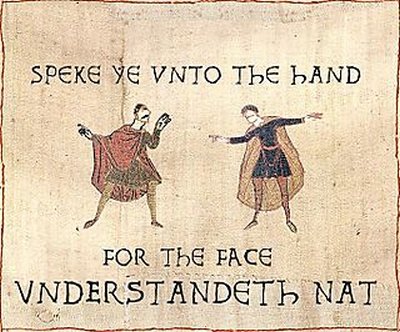





 ,
,  , and
, and  virtually speak for themselves. Illustrated by the delightful Martin Brown and others, there are puns, jokes, incredible stories, side-splitting captions, and all manner of fun. I’d recommend them to anyone who wants to stuff their kids’ heads with something without the child catching on to the parent’s nefarious scheme to make them enjoy getting smarter. You can buy them on the cheap, often starting as low as $.01 on Amazon, I already own a sizable (and growing) collection that still makes me laugh.




 Small Dog Syndrome